Linn
Linn Urika Internal Phono Stage
Linn Urika Internal Phono Stage
Please Call for Availability
Linn Urika Internal Phono Stage
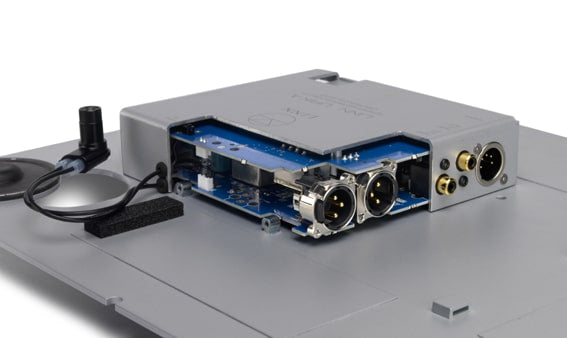
The Urika is the definitive analogue internal phono stage for the Sondek LP12 — a fully analogue moving coil phono stage that mounts inside the LP12 plinth and eliminates the cable run between tonearm and phono stage that has been the primary compromise in LP12 analogue replay since the turntable was first designed. By bringing the phono stage to the cartridge rather than routing the cartridge signal across the room, the Urika removes the principal source of noise and interference from the most signal-critical section of the entire chain. This is not a marginal improvement — it is a structural change to the signal path, and its consequences are audible from the first record.
Why Internal Mounting Changes Everything
Moving coil cartridges produce signals of extraordinary delicacy — typically well under 1mV, at impedances that make every unshielded cable a potential antenna for electromagnetic interference. A conventional external phono stage, however carefully engineered, receives a signal that has already travelled the length of a cable run from the tonearm. The Urika receives a signal that has not. The tonearm connects to the Urika via Linn's T-Kable — a fully screened differential cable designed specifically for this short internal run — and the differential geometry minimises common-mode interference over even this brief distance.
The Urika mounts on an integrated Trampolin base board inside the LP12 plinth, applying the same mechanical isolation philosophy that underpins the LP12's suspended sub-chassis to the phono stage electronics themselves. The motor, bearing, and sub-chassis do not transmit mechanical energy into the signal path through the phono stage chassis — the electronics are decoupled from vibration sources by design, not by distance.
Dual Mono Circuit Architecture
Left and right channels follow entirely separate signal paths through every gain and equalisation stage, with no shared component between channels. Channel crosstalk is controlled by architecture rather than by screening — the correct engineering approach at phono level, where the signals involved are small enough that any shared circuit element becomes a crosstalk mechanism. The result is a channel separation and stereo image precision that a single-channel shared circuit cannot match.
Power Supply — Radikal as the Foundation
The Urika is powered exclusively by the Linn Radikal motor controller — either the Standard Radikal or the Klimax Radikal. This is the correct engineering decision: the Radikal's precision regulated supply output provides the Urika with clean, low-noise power derived from the same supply that controls the LP12's motor with submicron precision. A Radikal is required — the Urika does not operate without one, and together they represent a complete motor control and phono stage solution designed as a system. An LP12 running Radikal and Urika is a fundamentally different instrument from one at Lingo or lower power supply specification.
Balanced and Unbalanced Outputs — Simultaneously Available
The Urika provides both direct-coupled RCA and transformer-coupled XLR outputs, available simultaneously. The RCA output is a direct-coupled unbalanced connection suitable for the vast majority of preamplifiers — low output impedance, wide compatibility, no transformer coloration in the signal path. The XLR output uses a signal transformer to provide true balanced connectivity: any common-mode interference picked up on the cable run between Urika and preamplifier is cancelled at the balanced input. On longer cable runs, or in environments with elevated electromagnetic interference, the balanced output provides a genuine signal quality advantage. Both outputs being simultaneously available means the Urika can feed two inputs without compromise to either.
Urika or Urika II — The Analogue and Digital Paths Diverge
The Urika and the Linn Urika II share a form factor and installation method but represent fundamentally different architectural choices. The Urika keeps the signal in the analogue domain throughout — amplified, equalised, and output via RCA or XLR to a conventional preamplifier. The Urika II converts to digital inside the plinth and outputs via Exakt Link to a compatible Linn Exakt DSM.
The choice is a system architecture decision. If you are running a Linn Exakt DSM and want the LP12 fully integrated into the Exakt chain, the Urika II is the correct choice. If you want to keep the LP12's signal in the analogue domain — feeding a conventional preamplifier, an integrated amplifier, or a non-Exakt Linn DSM — the Urika is the reference-level internal phono stage for that path. It is not a lesser alternative to the Urika II. It is the definitive solution within its own domain.
Technical Specifications
| Type | Internal moving coil phono stage |
| Signal domain | Fully analogue |
| Installation | Inside LP12 plinth, on integrated Trampolin base |
| Circuit topology | Dual mono |
| Output — unbalanced | Direct-coupled RCA |
| Output — balanced | Transformer-coupled XLR |
| Simultaneous outputs | Both RCA and XLR available simultaneously |
| Tonearm connection | Linn T-Kable (fully screened differential) |
| Power supply | Linn Radikal (required — Standard or Klimax) |
| Compatible cartridges | Moving coil |
Who Is It For?
The Urika is for LP12 owners who want the highest analogue phono stage performance the LP12 platform can deliver, who are running or intend to run a Radikal power supply, and who want to keep the signal in the analogue domain. It is the correct choice for those whose system does not include a Linn Exakt DSM — and the correct choice for any LP12 owner for whom the analogue signal path is not a compromise to be engineered around, but the entire point.
Combined with the Linn Karousel Bearing Kit on any pre-2020 deck and the correct tonearm — the Linn Krane Tonearm at entry level or the Linn Arko Tonearm above it — the Urika delivers a level of analogue performance that no external phono stage can replicate, because no external phono stage can be this close to the cartridge.
Buying from Martins Hi-Fi
Martins Hi-Fi has been in Norwich since 1968. Elizabeth Gould runs the business today, and we stock only brands we have heard properly and stand behind.
The Urika requires professional fitting inside the LP12 plinth and correct integration with the Radikal power supply — precision work that must be carried out by an experienced Linn specialist. We carry out the complete installation as part of our LP12 servicing work, and the deck will not leave our workshop until the Urika is correctly installed, powered, and verified. If the Urika is part of a broader LP12 upgrade — alongside a Radikal installation, a tonearm change, or a cartridge upgrade — we will plan the complete sequence with you before any work begins.
When you get in touch, you'll be speaking with Dave and Chris — experienced specialists who can advise on this product and your whole system.
Contact us at info@martinshifi.co.uk, call 01603 627010, or WhatsApp on 07554 687137. You can read more about how we work on our Why Martins Hi-Fi page. We are at 85–91 Ber Street, Norwich, NR1 3EY.