Collection: Entreq
Entreq: The Boxes That Got Laughed At
When Entreq introduced the original Tellus in 2007 — a sealed box of minerals with a wire coming out of it, sold on the claim that your mains earth was polluting your music — the trade's response was, in Entreq's own words, a lot of ridicule. Fair enough, probably. It had no power lead, no switch, nothing that moved and nothing on a spec sheet anyone could argue with. It looked like the sort of thing sold to people who have run out of things to buy.
Nearly twenty years on, a number of serious manufacturers sell grounding products of their own. Entreq were there first, and took the mockery for it. That is not proof of anything — plenty of nonsense has spread through hi-fi on enthusiasm alone — but it is reason enough to give the argument a hearing before dismissing it.
The argument, minus the mysticism
Entreq's claim is narrower and considerably more boring than the price tags suggest. The earth in your wall is a safety conductor. It exists to carry fault current at 50Hz and stop you being electrocuted, and at that job it is excellent. What it was never designed to be is quiet. It is shared with the fridge, the router, the dimmer in the hall and every switch-mode supply in the building, all of them dumping high-frequency noise onto it.
The problem is that your electronics use that same connection as their voltage reference — the zero point against which every musical signal is measured. Move the zero around and the smallest signals, the ones sitting closest to it, are the first to smear.
A ground box does not replace the safety earth, and Entreq are explicit that it must not. It sits alongside it, offering high-frequency noise an easier way out of the circuit than the one it is currently using. The mineral fill inside is frequency-selective by design: high impedance across the audio band, lower impedance up in the MHz and GHz, so what drains away is interference and what stays is music. The granular structure gives an enormous internal surface area, and the RF energy that wanders in becomes a vanishingly small amount of heat and stops troubling the amplifier. Nothing is filtered and nothing is cancelled. Nothing is added to the signal path at all — the entire exercise is a subtraction.
You can decide for yourself whether that is physics or faith. We would only observe that Entreq now argue their case in the language of impedance, dielectric loss and skin effect, which is not the language snake oil usually chooses.
What it sounds like, and who should ignore it
Because the effect is a removal, it is an awkward thing to demonstrate and an easy thing to oversell. Nothing gets louder. Nothing gets warmer. What changes is what survives underneath: the decay of a piano note going out into the room instead of simply stopping, the shuffle of an audience, the breath before a phrase. Put on Sunday at the Village Vanguard — a record whose whole atmosphere is a room with people and glassware in it — and the difference is in how much of the Vanguard turns up alongside the trio.
The honest demonstration is the reverse one. Adding a ground box is easy to talk yourself into hearing. Taking one away, unannounced, halfway through a record you know intimately, is much harder to talk yourself out of — so that is the version we prefer to do. It is also the one that tends to end the conversation.
Some people should ignore all of this. If your system does not resolve much below its own noise, a ground box has nothing to uncover and will do very little for you; we would rather say so than sell you one. Entreq rewards what is already there, which means for most systems the money belongs somewhere else first. It is also a game of firm diminishing returns: the step from no grounding to a modest box is the largest one you will ever hear, and each step after costs more and gives back less. Start small. Anyone urging you to begin at the top is selling.
Where to start, and where it goes
The way in is the Micro Kit Tungsten or the Macro Box Tungsten Kit: a single box, a single cable, and an answer to the only question worth asking at this stage — whether you hear anything at all. Most people begin at a source or a phono stage, since low-level circuits have the most to gain, and the Macro Box Tungsten Twin Kit covers two components.
The middle of the range is where most systems settle. The Silver Minimus Tungsten is the sensible second step, and above it sit the Tellus 3 Tungsten and Silver Tellus Tungsten — the name having survived, not accidentally, since the box everyone laughed at. More mass and more mineral, and the capacity to take noise from more of the system at once.
Above that the range stops being sensible and becomes the Olympus family, which is where Entreq put their grounding research when nobody is asking them to be reasonable about cost. The Olympus 10 Tungsten is the way in, and the practical appeal at this level is that one box can serve a complicated system where otherwise you would be buying several. The Olympus Infinity T, Olympus TEN TEN, Pluton and Olympus Hero go further still. These are for systems where everything else has already been dealt with.
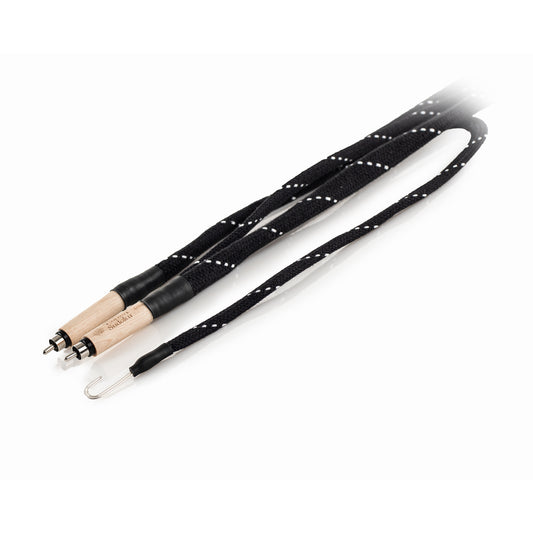
A box is only as good as the wire reaching it, which is why the Eartha ground cables run to a full range of their own — from the Eartha Copper through the Eartha Revelation and Eartha Apollo to the Eartha Olympus. Upgrading the cable to an existing box is frequently better value than upgrading the box.
The same thinking runs through the rest of what they make. The signal, speaker and power cables — gathered in the Entreq cable collection — carry a drain wire that leaves the cable and goes to a ground box instead of dumping interference into the chassis at either end. The Athena rack has a fine silver mesh woven into the shelf itself — Entreq call it Silvernet — with a binding post so the shelf can be drained too; the Wilma is the half-size rack. Protectus and the VIBBEATER take on the magnetic and mechanical ends of the same argument. Everything is made by hand in Åstorp, in southern Sweden.
Hear Entreq in Norwich
Per-Olof Friberg, who founded Entreq and still owns it, has been to Ber Street twice — twice more than most manufacturers manage. Both visits left us better at explaining what his boxes do, and considerably more careful about what they don't.
So come and be sceptical at us. Bring the record you know better than any other, the one whose flaws you could recite from memory, and ask us to take the box out halfway through without telling you when. If nothing happens, nothing happens, and you will have saved yourself a good deal of money. If something does, you will know what you heard rather than what you were told. The full Entreq range is here, and the team can talk through where a box would actually do something in your system and where it would only be expensive. Arrange a listen with the team.
Martins Hi-Fi 85-91 Ber Street, Norwich NR1 3EY 01603 627010 info@martinshifi.co.uk

-
Entreq VIBBEATER
Regular price From £120.00 GBPRegular priceUnit price per -
Entreq PRIMER BRAID QSA BAR 6
Regular price £2,680.00 GBPRegular priceUnit price per -
Entreq Max Ti
Regular price £450.00 GBPRegular priceUnit price per -
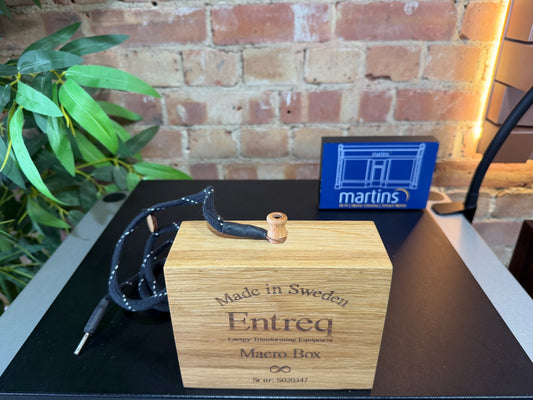
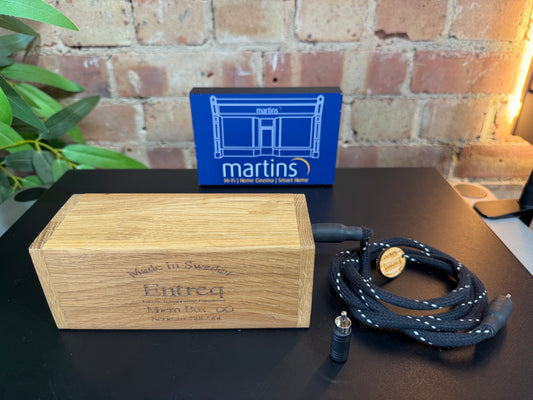
Entreq Macro Ground Box | Ex-Demo | 1.1M Cable & RCA Adaptor
Regular price £299.00 GBPRegular priceUnit price per -
Entreq Micro Ground Box Ex-Demo
Regular price £149.00 GBPRegular priceUnit price per -
Entreq Mini Wraps Tungsten
Regular price £60.00 GBPRegular priceUnit price per -
Entreq AC Wraps Tungsten
Regular price £120.00 GBPRegular priceUnit price per -
Entreq Magneus Supreme
Regular price £2,100.00 GBPRegular priceUnit price per -
Entreq Magneus Power
Regular price £880.00 GBPRegular priceUnit price per -
Entreq Magneus Signal
Regular price £380.00 GBPRegular priceUnit price per -
Entreq Wilma Equipment Support
Regular price From £280.00 GBPRegular priceUnit price per -
Entreq Olympus Cleanus
Regular price £8,000.00 GBPRegular priceUnit price per -
Entreq Cleanus Tungsten
Regular price £3,650.00 GBPRegular priceUnit price per -
Entreq Olympus Powerus
Regular price £10,400.00 GBPRegular priceUnit price per -
Entreq Powerus T2
Regular price £4,800.00 GBPRegular priceUnit price per -
Entreq Sudoku Core Speaker Cable
Regular price £5,000.00 GBPRegular priceUnit price per -
Entreq Sudoku Core Signal Cable
Regular price £2,800.00 GBPRegular priceUnit price per -
Entreq Sudoku Core Digital Signal Cable
Regular price £2,200.00 GBPRegular priceUnit price per -
Entreq Sudoku Core Power Cable
Regular price £4,000.00 GBPRegular priceUnit price per -
Entreq Delphius Speaker Cables
Regular price £3,200.00 GBPRegular priceUnit price per