Linn
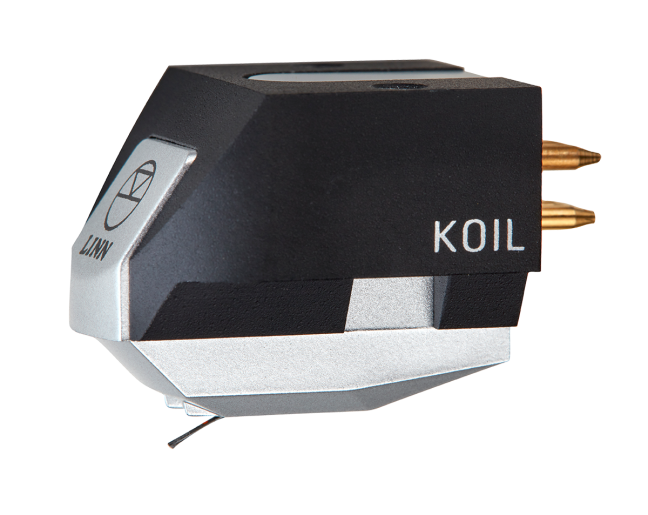
Linn Koil Moving Coil Cartridge
Linn Koil Moving Coil Cartridge
Available to Order
Linn Koil Moving Coil Cartridge
The Linn Koil is an entry-level moving coil cartridge. It uses a nude microlinear stylus on a low mass boron cantilever, a trapezial armature, and 1.2mm gold pin connections. Output voltage is 0.4mV at 5cm/s, with a specified load resistance of 100Ω and load capacitance of 1nF.
Moving Coil Generator
Moving coil cartridges wind the coils directly onto the cantilever assembly, which moves within a fixed magnetic field. The moving mass is kept extremely low as a result — and it is this that gives MC cartridges their advantage in high-resolution vinyl replay. The Koil's trapezial armature keeps the coil assembly compact and symmetrical, which contributes to its channel balance specification of 1.0dB at 1kHz and channel separation of 27dB at 1kHz.
Nude Microlinear Stylus
The Koil uses a nude microlinear stylus — nude meaning the diamond is bonded directly to the cantilever rather than mounted on a metal shank, keeping the moving mass as low as possible. The microlinear profile gives a precise, elongated contact patch with the groove wall, tracing high-frequency groove modulations that a standard elliptical stylus would bridge over. It is a stylus profile associated with moving coil cartridges at considerably higher price points, and its presence here is one of the defining characteristics of the Koil.
Low Mass Boron Cantilever
The cantilever is boron — a material chosen for its exceptional stiffness-to-mass ratio. A boron cantilever transmits groove modulations to the generator with minimal energy loss in the material itself, and its low mass means the stylus assembly responds quickly to rapid changes in the groove. This combination of stylus profile and cantilever material gives the Koil a technical foundation that goes well beyond what its position as an entry-level MC cartridge might suggest.
Mounting and Compatibility
The Koil uses a 2-point mounting system and 1.2mm gold pin connections. Tracking force runs between 1.8 and 2.2g, with a nominal setting of 2.0g. Load resistance is specified at 100Ω and load capacitance at 1nF. Cartridge mass is 7.6g.
Technical Specifications
| Specification | Value |
|---|---|
| Type | Entry-level moving coil cartridge |
| Stylus Type | Nude Microlinear |
| Cantilever | Boron |
| Armature | Trapezial |
| Coil Wire | Copper |
| Pin Connection Type | 1.2mm gold pin |
| Mounting Points | 2 |
| Output Voltage | 0.4mV @ 5cm/s |
| Channel Balance at 1kHz | 1.0dB |
| Channel Separation at 1kHz | 27dB |
| Load Resistance | 100Ω |
| Load Capacitance | 1nF |
| Tracking Force | 1.8–2.2g (2.0g nom) |
| Cartridge Mass | 7.6g |
Who Is It For?
The Koil is an entry-level moving coil cartridge with a specified load resistance of 100Ω and output voltage of 0.4mV at 5cm/s. Those looking to build a more complete Linn front end will find the Linn Karousel Bearing Kit and the Linn Klimax Radikal motor control worthwhile companions, while the Linn Krane Tonearm and Linn Arko Tonearm are the natural tonearm partners. Those ready to take the next step up the Linn cartridge range should consider the Linn Krystal Moving Coil Cartridge, and at the summit sits the Linn Kandid.
Buying from Martins Hi-Fi
Martins Hi-Fi has been in Norwich since 1968. Elizabeth Gould runs the business today, and we stock only brands we have heard properly and stand behind.
You are welcome to hear the Linn Koil at our Norwich showroom, where we can demonstrate it on a suitable LP12 configuration and show you what entry-level moving coil performance from Linn sounds like in practice. When you get in touch, you'll be speaking with Dave and Chris — experienced specialists who can advise on this cartridge and your whole Linn system.
Contact us at info@martinshifi.co.uk, call 01603 627010, or WhatsApp on 07554 687137. You can read more about how we work on our Why Martins Hi-Fi page. We are at 85–91 Ber Street, Norwich, NR1 3EY.