Linn
Linn Klimax Solo 500 Mono Power Amplifier
Linn Klimax Solo 500 Mono Power Amplifier
Available to Order
Linn Klimax Solo 500 Mono Power Amplifier
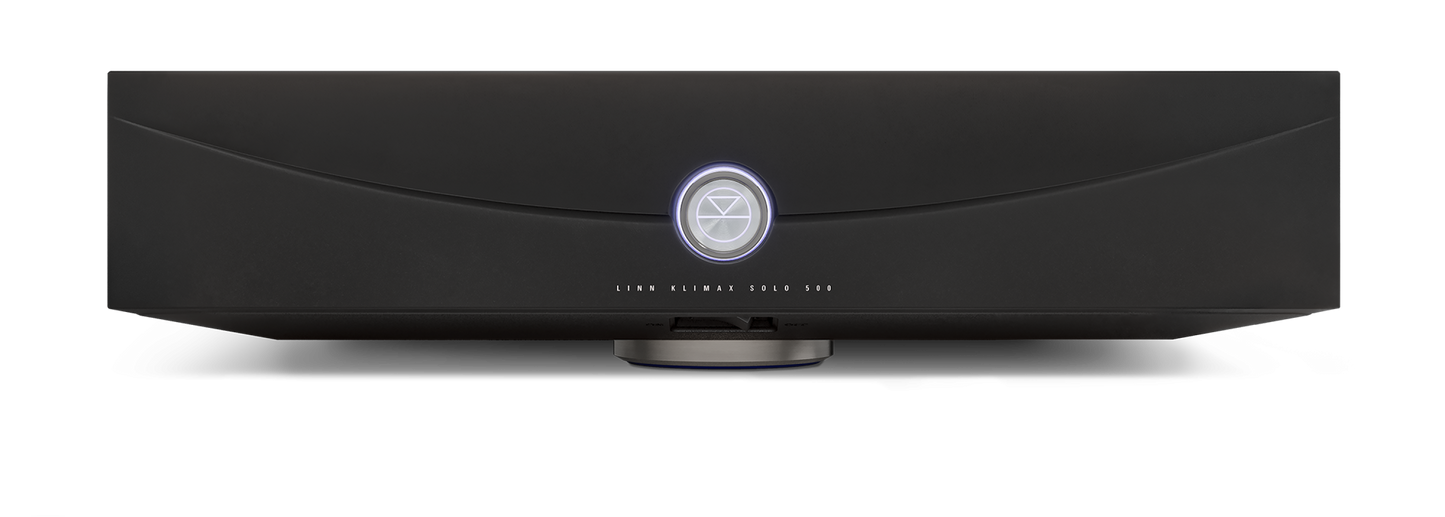
The Klimax Solo 500 is Linn's entry point into reference monoblock power amplification — 500 watts of Class AB output from a single-channel chassis, hand-assembled in Glasgow, and the amplifier specified for listeners who want Klimax-standard power amplification without the passive-cooling engineering investment of the Linn Klimax Solo 800. At £23,500 per unit — a stereo pair requiring two — the Solo 500 delivers a THD+N figure of 0.0005% at rated output, an Utopik power supply, and Adaptive Bias Control technology whose effect on the operating behaviour of the Class AB output stage is not a refinement of conventional amplifier design but a fundamental departure from it. This is not an amplifier that manages crossover distortion. It is an amplifier whose architecture eliminates the conditions under which crossover distortion occurs.
The Solo 500 sits alongside the Linn Klimax Solo 800 as Linn's reference monoblock offering — the 500 the correct choice where 500 watts is the appropriate power level and hybrid cooling is acceptable; the 800 the answer for those who require 800 watts of continuous output from a chassis that is completely silent under all operating conditions. Both share the same Adaptive Bias Control architecture and the same engineering philosophy. The distinction is power output, thermal management, and the investment required to achieve passive cooling at reference power levels.
Adaptive Bias Control — Eliminating Crossover Distortion Behaviourally
Class AB amplification is a compromise defined by a single engineering decision: the bias current is set at a fixed level. That fixed bias point is a calibration — an attempt to minimise crossover distortion under typical operating conditions — but it is a static response to a dynamic problem. As the output stage heats in use, the bias point drifts. At low signal levels, where the output stage operates closest to the crossover region, the fixed bias cannot adapt to the precise signal condition at that moment. The result is crossover distortion — a hardness and grain in the presentation at low listening levels, in the very dynamic region where musical texture, spatial information, and low-level detail are primarily communicated.
Adaptive Bias Control replaces the fixed bias with a continuous, real-time monitoring and adjustment of the bias current across the output stage — responding to signal level and temperature simultaneously, on every cycle of the output waveform. The crossover region is not managed from a static bias point that drifts with temperature. It is continuously optimised — the output stage operating at the correct bias for the signal it is handling at every moment. The conditions under which crossover distortion occurs are not reduced. They are removed.
Linn reports this achieves a THD+N figure of 0.0005% at rated output — 85 times lower than previous generation designs. At low listening levels, the consequence is the absence of the hardness that defines conventional Class AB operation in that regime. Low-level detail, transient edges, and the spatial and timing information encoded in a recording are resolved without the characteristic contamination of crossover distortion. The Klimax Solo 500 performs at reference standard not only at full power, but across the entirety of the dynamic range — at the levels where music actually lives.
Utopik Power Supply — The Foundation of the Performance
The Utopik power supply fitted to the Klimax Solo 500 is the same supply used across Linn's current-generation DSM source components — a switch-mode design with Intelligent Valley Switching and active Power Factor Correction whose engineering discipline addresses power supply noise at the source rather than managing it after the fact. Intelligent Valley Switching synchronises the switching events in the power supply to the points in the mains waveform where current transitions are smoothest, eliminating the electromagnetic interference that arbitrary switching generates rather than screening against it. Active Power Factor Correction ensures the supply draws current from the mains smoothly — imposing no reactive loading and contributing nothing to the electromagnetic environment of the system.
The consequence is a stable, low-noise supply that feeds the amplification stage with a consistency and cleanliness that a conventional supply topology cannot approach — and whose contribution to the Solo 500's noise floor performance is measurable and audible.
Hybrid Cooling — FPGA-Controlled and Acoustically Managed
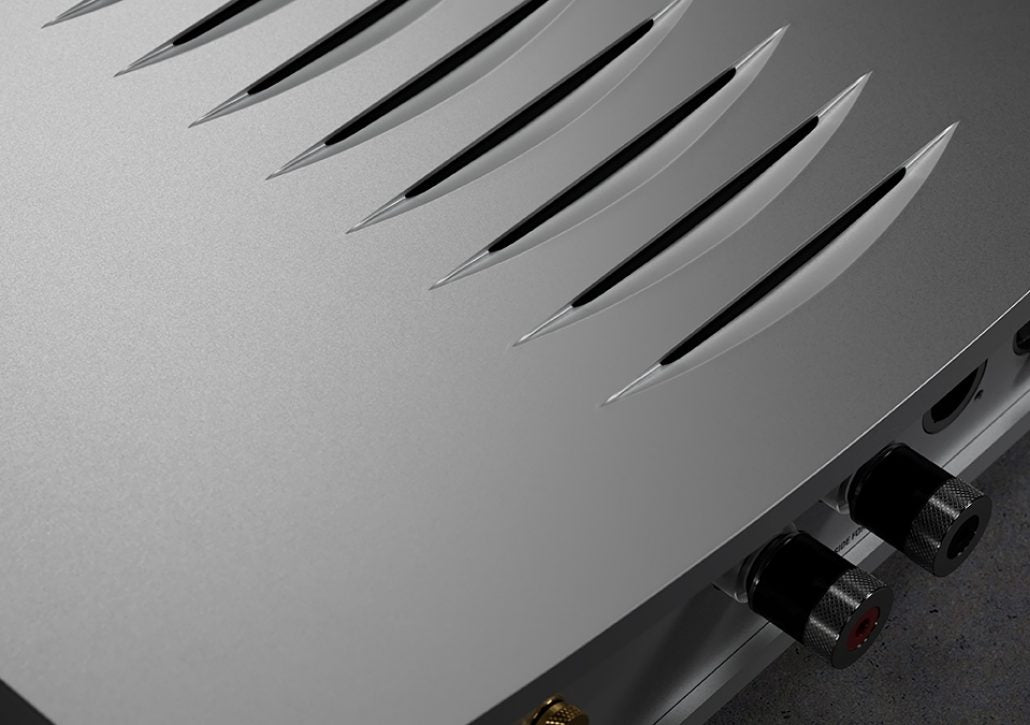
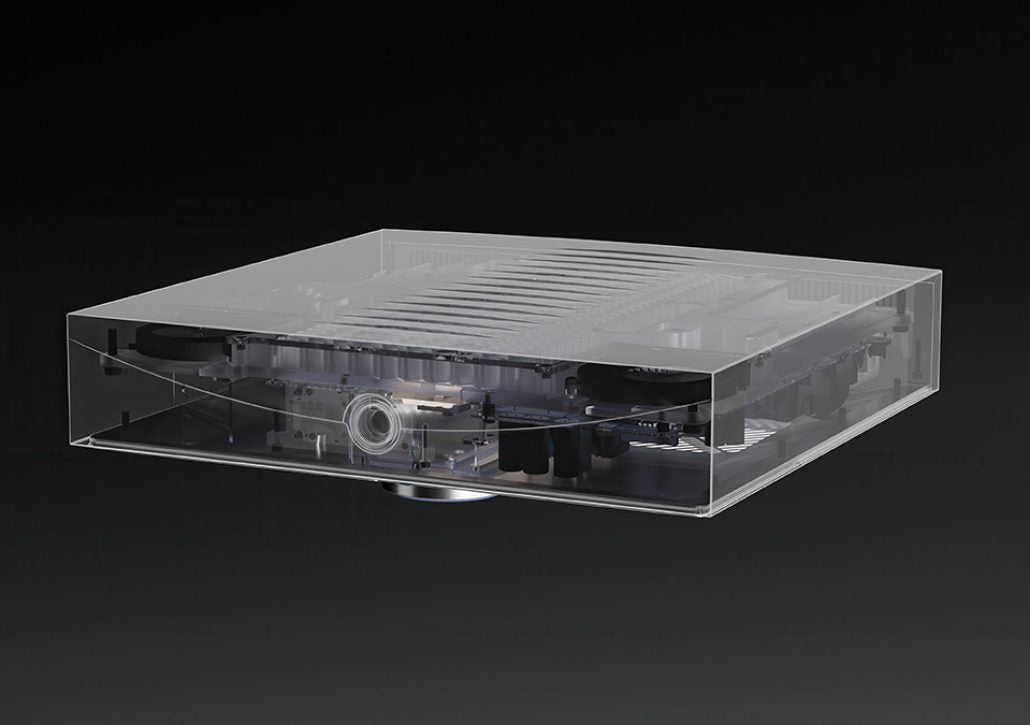
The Klimax Solo 500 manages its thermal load through a hybrid cooling matrix: passive thermal mass supplemented by FPGA-controlled fans that operate in response to output power demands rather than at a fixed speed. The FPGA monitors temperature continuously and adjusts fan speed to the minimum required for the thermal load at that moment — at typical listening levels, the fans operate at acoustic levels that do not intrude during normal use. Under sustained high-power conditions, fan speed increases proportionally; at low-to-moderate output levels, the amplifier operates in acoustic conditions approaching passive silence.
This is a meaningful and considered engineering decision. For those for whom completely silent operation under all conditions is an absolute requirement, the Linn Klimax Solo 800 eliminates the fans entirely through the greater thermal mass of its larger chassis. For those whose listening habits do not routinely demand sustained maximum output, the Solo 500's hybrid approach delivers the same Adaptive Bias Control performance at a substantially lower investment per unit.
Chassis and Connections
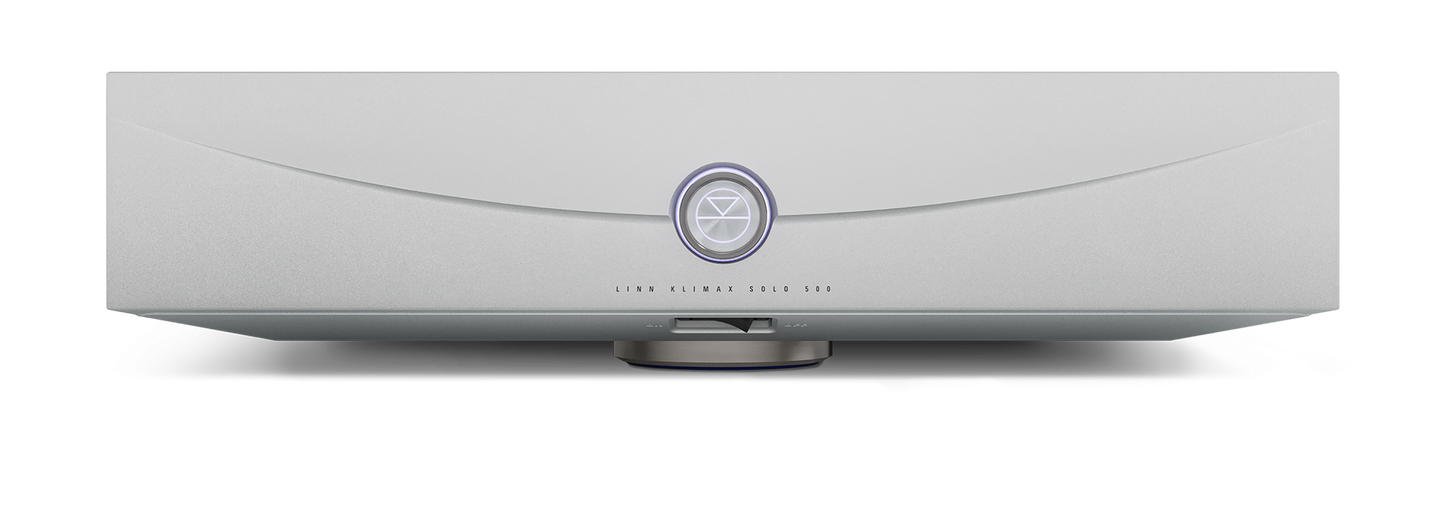
The Klimax Solo 500's chassis is machined from aluminium and hand-assembled at Linn's Glasgow factory — the same facility responsible for the Linn Klimax System Hub and the Linn Klimax LP12. At 350 × 88.5 × 364 mm and 10.6 kg, the Solo 500 is notably compact for its power output — a consequence of the Utopik supply's efficiency and the Adaptive Bias Control architecture's reduced heat generation relative to conventional Class AB designs. It fits a standard rack shelf without the thermal management footprint that a conventional high-power amplifier demands.
Inputs include balanced XLR and unbalanced RCA, with passthrough functionality supporting two-source or bridging configurations. Speaker connections use flexible binding posts suited to most termination types.
Technical Specifications
| Configuration | Monoblock — one channel per unit |
| Output power | 500 W into 4 Ω; 250 W into 8 Ω |
| Amplifier class | Class AB with Adaptive Bias Control |
| THD+N | 0.0005% at rated output |
| Cooling | Hybrid matrix with FPGA-controlled fans |
| Inputs | Balanced XLR; unbalanced RCA; passthrough |
| Power supply | Utopik — Intelligent Valley Switching, active Power Factor Correction |
| Dimensions (W × H × D) | 350 × 88.5 × 364 mm |
| Weight | 10.6 kg per unit |
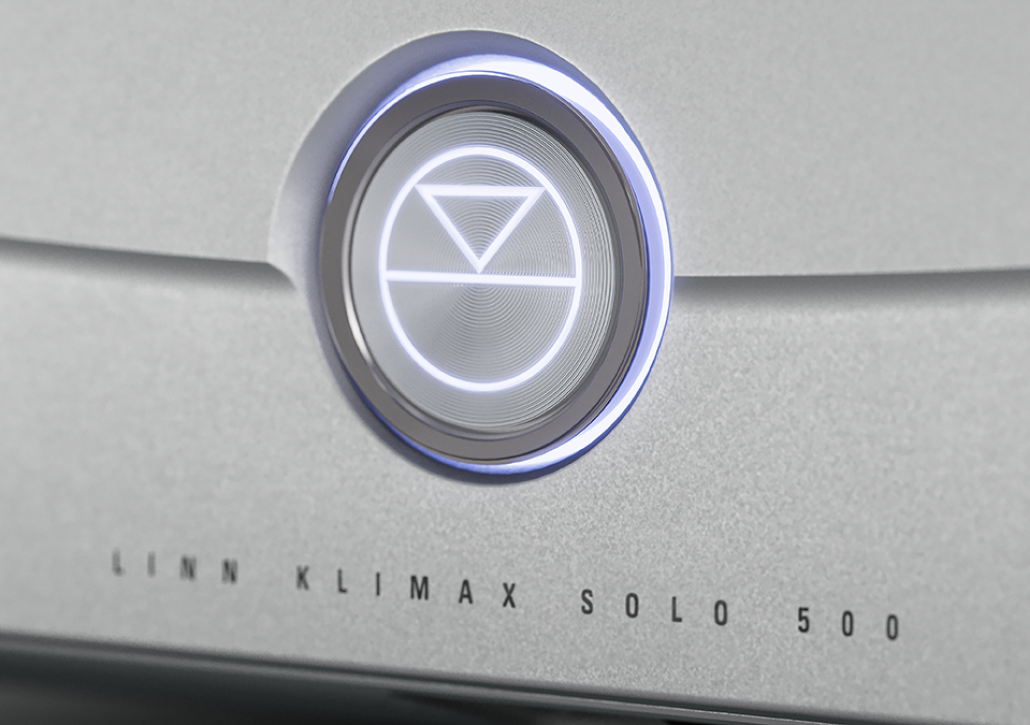
| Finish | Machined aluminium — silver or black |
| Assembly | Hand-assembled, Linn Glasgow factory |
Who Is It For?
The Klimax Solo 500 is for the listener building a reference-level Linn system around the Linn Klimax System Hub who requires monoblock power amplification to drive passive loudspeakers at the highest standard — including demanding loads with complex impedance characteristics or low sensitivity. It pairs naturally with the Linn Klimax LP12 as the analogue source in a complete Klimax system, and works equally with non-Linn loudspeakers whose impedance and sensitivity characteristics are within the Solo 500's operating envelope. Those for whom 500 watts is insufficient, or for whom passive cooling under all conditions is a non-negotiable requirement, should consider the Linn Klimax Solo 800. For those building an active system rather than a passive one, the Linn 360 Active Loudspeaker integrates Adaptive Bias Control amplification within the loudspeaker — a different and compelling architectural answer to the question of reference-level active performance.
Buying from Martins Hi-Fi
Martins Hi-Fi has been in Norwich since 1968. Elizabeth Gould runs the business today, and we stock only brands we have heard properly and stand behind.
A Klimax Solo 500 purchase is always a system conversation — source, preamplification, loudspeakers, cabling, and room all bear on what the Solo 500 delivers, and we would want to understand each of those variables before advising. The Solo 500 can be demonstrated at our Norwich showroom in a complete Klimax system context.
When you get in touch, you'll be speaking with Dave, Chris and Tim — experienced specialists who can advise on this product and your whole system.
Contact us at info@martinshifi.co.uk, call 01603 627010, or WhatsApp on 07554 687137. You can read more about how we work on our Why Martins Hi-Fi page. We are at 85–91 Ber Street, Norwich, NR1 3EY.