Linn
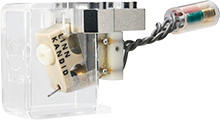
Linn Kandid Moving Coil Cartridge
In stock
Linn Kandid Moving Coil Cartridge
The Kandid sits at the upper end of Linn's cartridge range — above the Kendo and below the flagship Ekstatik, and designed specifically to partner the Ekos SE tonearm on a high-specification LP12. At £4,175, it occupies genuinely reference territory: a cartridge whose nude generator design and ceramic boron cantilever represent engineering choices that place it among the most technically accomplished moving coil designs available at anything approaching its price. The Kandid is not a cartridge for the uncommitted listener. It is the correct choice for an LP12 owner at Klimax or high-specification Selekt level who wants reference-class cartridge performance without the full Ekstatik investment, and who has an Ekos SE arm capable of revealing everything the Kandid retrieves.
Nude Generator — Eliminating the Housing
The defining characteristic of the Kandid's design is the absence of a generator housing. In a conventional moving coil cartridge, the generator assembly — coil, cantilever mount, and magnetic assembly — is enclosed within a body. That body provides mounting points and mechanical support, but it also introduces resonance. However carefully the housing is designed and however precisely it is machined, it is a structure that vibrates — and its vibrations, however small, contaminate the signal that the generator produces.
Linn's position with the Kandid is unequivocal: the housing is unnecessary and its contribution is harmful. By exposing the generator directly — mounting it without a surrounding structure — Linn removes an entire class of resonance from the signal path. The practical result is a cleaner, lower-distortion signal from the generator: a more accurate representation of what the stylus retrieved from the groove, presented to the phono stage without the coloration that even a well-engineered housing introduces. The nude generator is not a novelty at reference cartridge level — it is the correct approach when the objective is the lowest possible coloration, and it is the architecture that Linn employs on both the Kandid and the Ekstatik above it.
Ceramic Boron Cantilever and Nude Line-Contact Stylus
The Kandid uses a ceramic boron cantilever — boron for its exceptional stiffness-to-mass ratio, ceramic process for the precision and dimensional consistency it delivers. Boron is one of the established reference materials for high-performance cantilever design: stiffer than aluminium by a significant margin, with internal resonances that sit well outside the audio band and therefore make no contribution to the signal in transit. The ceramic boron process produces a cantilever that is simultaneously lighter and more rigid than alternative fabrication methods — transmitting groove modulations to the generator with a speed and accuracy that conventional cantilever materials cannot approach.
The stylus is a nude line-contact diamond — the diamond is a complete stone, not a chip bonded to a metal shank, and the line-contact profile contacts the groove wall over a narrow, precisely defined area that follows the geometry of the original cutting stylus more closely than any less sophisticated profile. Tracking geometry is set at 20 degrees, maintaining symmetrical flux lines across the Kandid's full range of motion and ensuring that the signal generated at every point in the groove is produced under consistent, correctly aligned conditions.
Coil winding is hand-wound. The precision of hand winding delivers the output voltage — 0.38mV at 3.54cm/s — from a generator of the lowest possible moving mass. The Kandid's output is lower than the Kendo's, reflecting the lower generator mass of the nude design; the signal quality from which that output is derived is higher. Triple-point mounting ensures installation geometry is accurate and repeatable — an important consideration at this level, where small alignment errors translate directly and immediately into audible degradation.
The Ekos SE Partnership
The Kandid is designed for the Ekos SE tonearm. This is not a suggestion and not a marketing convenience — it is an engineering decision. The Ekos SE's bearing precision, effective mass, and arm wand geometry are specified to work with the Kandid's compliance, output, and mounting geometry. Running the Kandid in any other arm on an LP12 is possible, but the cartridge and arm were developed in relation to each other, and the correct realisation of the Kandid's capabilities requires the correct arm. If your current tonearm is an Arko, the Kendo is the more appropriate cartridge choice — the Kandid should be considered when the arm is, or is to become, an Ekos SE.
Kandid in the Linn Cartridge Hierarchy
The Krystal introduces moving coil architecture at Majik specification. The Kendo raises that to a boron cantilever and super-fine-line stylus for Arko builds. The Kandid steps further: nude generator, ceramic boron cantilever, nude line-contact stylus, and hand-wound coils — a combination that addresses resonance and distortion at a more fundamental level than any cartridge below it in the range. The Ekstatik above it employs a micro-ridge stylus and Linn's most advanced generator assembly; the Kandid sits at the level directly below that, sharing the nude generator architecture and ceramic boron cantilever, and distinguished by the Ekstatik's additional stylus sophistication and the incremental generator development that justifies the price difference between them.
For LP12 owners at Klimax specification, the question between Kandid and Ekstatik is a genuine one — and one worth addressing at our Norwich showroom rather than on the basis of specification sheets alone.
Technical Specifications
| Type | Moving coil |
| Generator design | Nude (exposed — no housing) |
| Output voltage | 0.38 mV @ 3.54 cm/s |
| Tracking force | 1.72–1.77 g |
| Channel separation | Better than 35 dB at 1 kHz |
| Channel balance | ± 0.5 dB at 1 kHz |
| Cantilever | Ceramic boron |
| Stylus profile | Nude line-contact diamond |
| Tracking geometry | 20 degrees |
| Body material | Precision-machined 7075-grade aluminium |
| Cartridge mass | 5.7 g |
| Load resistance | 50–200 Ω |
| Load capacitance | 100–1000 pF |
| Coil wire | Copper |
| Mounting points | 3 |
Who Is It For?
The Kandid is for LP12 owners running an Ekos SE who want reference-level cartridge performance short of the Ekstatik — the correct choice at high-specification Linn LP12 Selekt Turntable and Linn Klimax LP12 builds where the Ekstatik's additional investment is not yet the right decision. It is also the natural next step for anyone currently running a Kendo on an Ekos SE, where the nude generator design and ceramic boron cantilever will deliver a clearly audible step up in low-level resolution, channel separation, and generator purity that the Kendo's conventional body architecture cannot match.
Pair it with a Urika or Urika II for an internal phono stage solution, or the Uphorik for an external MC phono stage — both are properly specified for the Kandid's output voltage and loading requirements.
Buying from Martins Hi-Fi
Martins Hi-Fi has been in Norwich since 1968. Elizabeth Gould runs the business today, and we stock only brands we have heard properly and stand behind.
The Kandid's nude generator design requires careful handling and precise alignment — this is not a cartridge to fit without professional experience. We carry out complete installation and alignment on our LP12 service bench as part of our LP12 servicing work, and the Kandid will not leave our workshop until every parameter — tracking force, azimuth, stylus rake angle, and anti-skate — is correctly set. If you are considering the Kandid alongside other system changes — a move to an Ekos SE arm, for example, or a sub-chassis upgrade — that conversation is best had before any orders are placed.
When you get in touch, you'll be speaking with Dave, Chris and Tim — experienced specialists who can advise on this product and your whole system.
Contact us at info@martinshifi.co.uk, call 01603 627010, or WhatsApp on 07554 687137. You can read more about how we work on our Why Martins Hi-Fi page. We are at 85–91 Ber Street, Norwich, NR1 3EY.
